

“How would YOU feel if that happened to you?”
“I wouldn’t care.”
I hear this type of exchange fairly often among parents and kids with ADHD. It can be difficult to teach an ADHD child about feelings. It was hard for me to learn about feelings when I was younger. I didn’t master this skill til my early 30s, but before you panic, keep in mind that my parents didn’t have the resources that we have today.
When I was young, I was considered uncaring, mean, and self-centered. From my own point of view, I would have given anything to feel like I fit in. Not completely (I was never going to be a “goody-two-shoes,” but just enough to not call attention to myself).
I lacked what is now called, “Emotional Intelligence” – an awareness of self and other, and the ability to manage my emotions, my thinking and my actions. I really didn’t understand why I wasn’t “caring.” I felt caring. I also felt like people made a big deal about being caring. I wanted to care but I just didn’t know how.
Let’s start with a definition
Two psychologists, Peter Salovey and John D. Mayer first coined the phrase, “Emotional Intelligence,” in 1990:
“Emotional Intelligence is the subset of social intelligence that involves the ability to monitor one’s own and others’ feelings and emotions, to discriminate among them and to use this information to guide one’s thinking and actions.”
We know that ADHD kids have trouble monitoring their own feelings (you’ve seen it at home), so let me offer some tips for teaching kids about feelings.
It’s hard for kids to understand how someone else feels if they don’t know how they themselves feel!
Tip 1 – What do emotions look like?
First of all, I really like the posters that have all kinds of emotions on them and, in addition, they have a face that matches that emotion. You can point to the feelings and the faces in order to teach your children how to read them in others. If you don’t want to buy one online, you can make one out of old magazines. It’s also helpful to stand in front of a mirror with your child so they can match the facial expression to the feeling. You can ask, “What does happy look like?” “How about anger?” “What about fear?” Make a game of it! (NOTE: don’t use emoticons. You want real people faces or illustrations that show “real” people, not emoticons).
Tip 2 – What do emotions feel like?
Another way that’s equally if not more important is to teach your child to locate feelings in their bodies. For example, sadness is often felt in the middle of the upper chest. (Yes, where the heart is!) But someone might also feel it in his or her throat or eyes, or somewhere else even.
When someone is nervous he or she might feel like vomiting or might breathe shallowly – not taking deep breaths.
The reason this is so very important is that learning to identify feelings in the body, even if you can’t identify them in your head, can help you know what action to take next. For example, if you’re nervous and your breathing is shallow, you can take deep belly-breaths (where your belly expands and contracts rather than your chest). Deep breathing calms anxiety so your child can learn to self-soothe with practice.
Tip 3 – Watch some TV!
Watching TV and movies is a great way to teach your children to identify feelings from the way a person’s voice sounds, their body position, and their facial expressions. TV and movies are like a treasure chest of emotions! Practice with your child so that they become “fluent” in body language. (Not cartoons though)
*
Lastly, take everyday opportunities to identify and chat (not lecture) about emotions. A short chat; you don’t want them tuning out. Also, you don’t need to phrase it like a lesson – “What would happen if… ?“ or “Why do you think that he said that?” Those kinds of questions come later, after your child is becoming comfortable with emotions.
Remember that ADHD kids already live with some discomfort because they can’t control their actions or thinking very well. You want to make them feel good about themselves, so keep the frustration and anger out of your voice, reward little triumphs, and just love them for where they are right now and hold in your heart a dream of where they can be in the future.
Do you have anything to add? How have you taught your kids or yourself about emotions? Scroll down to the comment section and share your experience, strength and hope
xo, Yafa
Copyright 2016 Yafa Luria/Margit Crane All Rights Reserved
====================
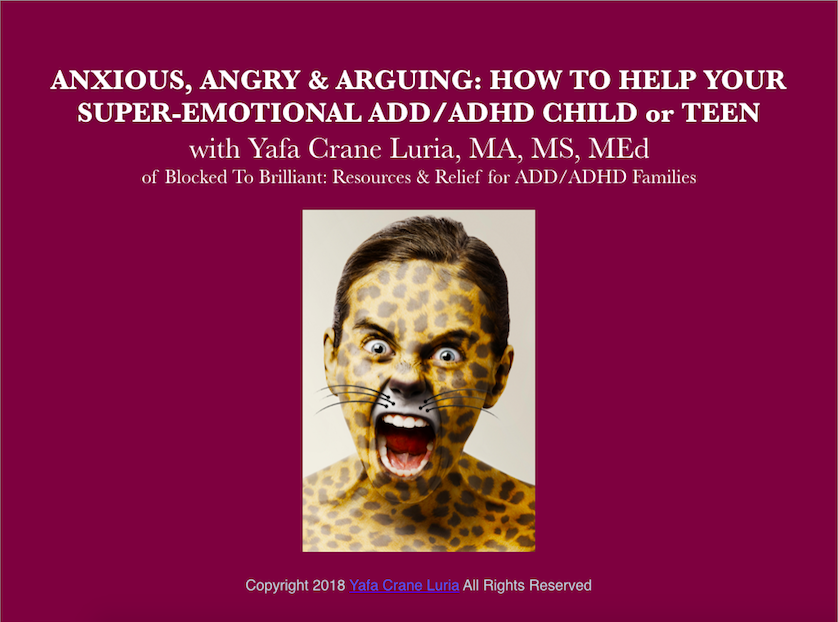
This is a great class for helping your kids and teens with emotional regulation:
Just click on the photo to purchase this 75-minute class.



When we were teaching our child with autism about emotions, we did a lot of self talk or talking out loud about our own feelings. We encouraged him to find words for his emotions in the moment. It’s so hard for our kiddos!
Great Penny! That’s a great addition to this information. Thank you!
Hi Margit,
Great post! I always learn something new about ADHD when I come to your posts! Thank you 🙂
Thanks so much, Joan.
Always a pleasure to see your smiling face!