* * * Spread the word!
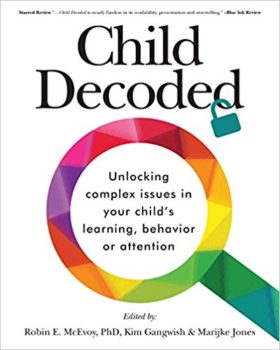 Child Decoded: Unlocking Complex Issues in Your Child’s Learning, Behavior or Attention
I am super picky about books about ADHD, I admit it. If it doesn’t have new information or isn’t compelling as far as a story, I just don’t care. So when I say that Child Decoded is an excellent handbook, I mean it. In fact, I’m giving it to a couple of my family members just so they have it around to refer to.
Whether your child/teen has already been diagnosed with a complex learning, behavioral, or attention issue, or whether your child/teen seems to defy diagnosis, this book is a great guide for the coming years. What I know for sure about these issues is that they are layered. It is rare for a child or teen to just have ADHD or to just have a math disability. In fact, when I polled parents on my Facebook page, I found that, on average, kids had 3-5 co-occurring diagnoses.
Don’t Panic!
Before you panic, every person has layered challenges, from cancer to shyness to fear of dogs to depression, we all have layered issues. It’s just that people don’t generally tell people with cancer to “get over it” or to “stop it and grow up.” They’re not called “lazy” or “unmotivated” when they can’t focus or they’re feeling cranky. Yet with these learning, behavior, and attention issues, the onus is on the challenged person to figure it out. Or the onus is on the parents. You’re not strict enough, you’re too strict, and so on. I’m sure you’ve heard it all. Child Decoded takes you and your child at face value.
One feature that I found very useful was the “Master Checklist” at the beginning of the book, that allows parents to check off those behaviors that concern them in each of eight categories. In this way, parents have a better idea of what may be going on with their child/teen, and the extent to which each may be the crux of the total picture. Just know that while this is a fantastic tool, it should be used in conjunction with consultations with a Doctor of Medicine (MD) or a Doctor of Naturopathy (ND), or both.
Each challenge addressed is covered with enough detail to give parents an idea of what their next step could or should be, which is super helpful when you’re baffled, stressed, and frustrated. The authors cover the following issues: ADD/ADHD, Speech and Language issues (including Auditory Processing Disorder, which is often misdiagnosed as ADD/ADHD), Sensory Processing Disorder, Autism, Learning Disabilities, Twice-Exceptionality, Emotional and Behavioral Issues, Social Skills issues, and also different treatment modalities.
“CJ”
The book opens with the story of young C.J. As a youngster, C.J. (and his parents) was overwhelmed by myriad anomalies in behavior, in learning and in attention. The author of this section writes:
“No wonder CJ was so wiped out! But even armed with so much new data [his diagnoses], our meetings with the school were frustrating. Everyone was very sympathetic, but with his high scores canceling out his abysmally low ones, CJ had actually not tested badly enough to qualify for any services from the district.”
How many parents have faced the very same issue? Have you?
What’s especially interesting to me about CJ is that I actually know him very well as a young adult! I didn’t know the extent of his challenges because he has so many impressive strengths. CJ is very well adjusted and he’s a fine human being that any parent would be proud of.
By the way, the main authors are all medical professionals of one kind or another, and CJ’s mother is a former therapist who specialized in trauma – no small feat. That’s one reason I’m a fan of the book. The contributors have extensive professional and personal experience with the topic and this underscores the point that parenting a child with behavior, learning, or attention issues is not about learning more and more and more; it’s about targeting your parenting to fit your own child, and this takes the help of an expert. Parenting our own kids isn’t easier just because we’re super smart or super experienced.
My one objection
The one issue I have with the book is both a personal and a professional concern: Despite the many interventions outlined, from psychiatry to eliminating certain foods, there is not a single mention of coaching, particularly ADHD coaching. Now, keep in mind that ADHD coaching has been a recommended treatment for ADHD since the 90s! But the person writing the section on ADHD is a Developmental Neuropsychologist and these, along with psychiatrists, often don’t understand the benefits of ADHD coaching, relying more on medication and, sometimes, therapy to resolve challenges.
While I am not against medication, I do believe that coaching is way more effective than therapy for ADHD challenges. You can read more about that HERE.
The good news is that I contacted one of the authors and she suggested that she and I do an interview together about the benefits of ADHD coaching. So I will post that interview for you when it happens.
In conclusion
My conclusion is the same as my opening: this is a user-friendly handbook that will help parents navigate the path of neuro-exceptionality from childhood into adulthood. To me, that’s a winner!
>>> You can listen in to my interview with Marijke Jones, one of the writers. She agreed that they should have had more about ADHD coaching!
xo, Yafa
Copyright 2018 Yafa Crane Luria All Rights Reserved
======================