<<< thanks for sharing!

When we think of ADHD as a deficit – perhaps not a mental deficit, but certainly a deficit as far as fitting into society and achieving life-long happiness and success – we unwittingly place our own fears above our children’s needs.
This is the message of author Deborah Reber in her book, “Differently Wired: Raising an Exceptional Child in a Conventional World.” * I’ve now read the book twice, and it’s even better the second time around!
Writing from the trenches
She writes, candidly and defiantly, about her own experience raising a “differently wired” child. Her 14 year old son, Asher, was diagnosed as Gifted, with Asperger’s and ADHD, and Debbie writes about the struggle to raise Asher in a way that would nurture his “differently wired” brain, not diminish it. Her story is the story of so many other parents whose kids have divergent brains.
One part that stood out for me is her very frank, very honest charge to other parents:
“If we really want a parenting paradigm that embraces and appreciates who our children are, we have to first own up to the ways in which we are contributing to keeping the outdated [model of normalcy] in place.”
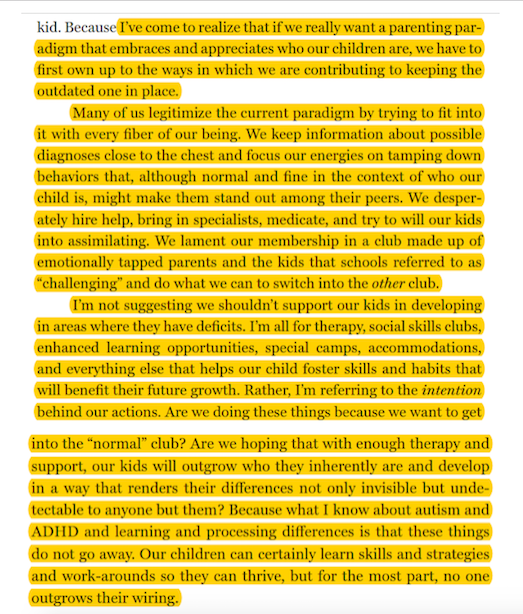
(Pages 76-77 from “Differently Wired: Raising an Exceptional Child in a Conventional World”
by Deborah Reber, Workman Publishing, New York, 2018)
Here’s the problem with the “Normal Club” (and it may not be what you think)
I know that you all see the problem with trying to get our kids to pass as “normal” – it doesn’t honor our children’s uniqueness, it’s pushy, and (at times) comes too close to cruelty to be comfortable. But here’s the thing you may not know: Your children desperately want to be in that club as much as you want them to be.
Now some of you may be saying, “Not my child, Yafa! My child loves his/her ADHD brain!”
I’m not going to argue that point or disagree with you, and what I know about the 1000’s of kids I’ve taught, counseled, and coached is this: 90% of the kids I’ve worked with since 1984, from the cheerleader to the stoner, from the student body president to the gang member, wants to belong to something meaningful and, in our society, that’s “The Normal Club.”
Those of us with ADHD have an inner voice (one of many) that reminds us that we’re not the same as the others: we’re more challenging, more frustrating, more confusing. We have a voice that tells us that “IF ONLY we could be more (fill in the blank), we would be more loved or more well-liked, at least. The voice tells us that we make your lives hard. It challenges us daily, “Can you not be a pain in the butt for one day?” or “Can you focus for one class?” or “Can you avoid getting a teacher’s note sent home just for today?”
We tend to feel bad quite a lot.
You want your kids’ lives to be as easy as possible, for sure. But when we compare our ADHD child/teen to other children/teens or even to his/her siblings, we are likely to despair. and that doesn’t help anyone, especially that wonderful, beautiful ADHD child that you were blessed with.
Please don’t underestimate the effect that the media has on us, directly or indirectly, when teachers, sports coaches, family members, or others are influenced by the words “deficit” and “disorder.”
The biggest threat to our futures is not our ADHD, but the way our ADHD is perceived.
There is tons of help out there – we parents don’t have to fear that our kids will fail. But what we do have to be mindful of is how much we long for (even in secret) that almighty membership in “The Normal Club.”
What can parents do?
1/ Assume that your child doesn’t need to change; Assume that your child needs to learn. ADHD doesn’t go away, but it also doesn’t have to stay the same as it is now, not for your children and not for adults with ADHD either. The brain can and does learn, and it can change. No, it’s not easy, but it can be done.
2/ Seek out help from ADHD experts. Facebook groups are great, and I wouldn’t take my broken leg to Facebook. When your family is hurting, anything less than expert help is just a band-aid for a broken leg. And there are so. many. people. that want to help you. Find people that will take the time to listen and will offer support, encouragement, and even love, instead of just a prescription or a “Tsk, tsk” or a “That’s too bad” shaking of the head. You don’t need people to feel sorry for you. That just feeds your own dismal inner voice.
3/ Commit to change. When you are learning, when your child is learning, there are going to be fits and starts, there’s going to be resistance. That is completely natural for the brain. AND… You actually don’t want quick change. First of all, generally speaking, quick change doesn’t last. Second, quick change can stun the system, which will then vigorously push back, much more so than when change is gradual. Change can be uncomfortable, but aren’t you already uncomfortable?
And last… Accept your children where they are, right now, today.

Acceptance doesn’t mean approval. It just means that you’re being realistic, loving, and supportive.
We can get pretty freaked out by the idea of acceptance if our kids are on drugs, or getting F’s in school, or are playing too many computer games. But here’s the good news, in the act of accepting, a lot of the noise and mindless chatter falls away, and your path becomes clearer.
For example, being a parent means thinking about and making decisions about thousands of little things every day. But if your child were in an accident and was lying in intensive care, you would be laser-focused on one thing – getting him/her well. You would not be thinking about the D’s and F’s, you would be focused on each present moment, because you would be in a state of acceptance.
Wherever your child is today – in this moment – he or she needs you to be there with him/her. When we are kids, our parents are the great loves of our lives – our hearts beat because of you and, more than anything, we want you to lead us into the future. If you’re afraid of their future – afraid of who they might become, then they’ll end up afraid too.
For today, accept your children exactly as they are, and love them there.
Regardless of what they may say to you, when kids are acting out or shutting you out, they’re afraid. Instead of joining them in their fear, learn how to take your leadership back in effective ways.
Forget about “The Normal Club,” and just love the heck out of your family, as messed up and hurting as it may be. That’s what your kids need, however uncomfortable it may be.
xo,Yafa
Copyright 2018 Yafa Crane Luria All Rights Reserved
* You can read my review of Debbie’s book HERE
====================

Did you know that ADHD Family Coaching makes parenting ALL your kids easier, not just your ADHD kiddo?
You know very well that ADD/ADHD affects everybody in the family, those that have it and those that don’t. It affects your focus, your schedule, and your money.
But having an expert in your back pocket, as it were, will streamline your efforts: you’ll be able to focus on workable actions and effective solutions. Your time and money and attention will be spent on bringing your family back together, in harmony with one another, instead of allocating a large chunk of your time and money on one child.
I train parents to become coaches for their kids, and change happens fast. There are some changes that you’ll see in just one day. You’ll change your tone of voice, or use a different phrase, and you’ll see a light go on for your child.
And that will jump-start the domino effect.
Join us in The Blocked to Brilliant Membership Club. It’s inexpensive because I know that ADHD is costly. Here’s what you get:

/join
====================