Differently Wired: Raising an Exceptional Child in a Conventional World
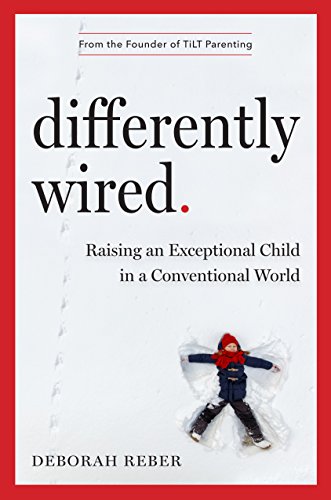 Differently Wired: Raising an Exceptional Child in a Conventional World is just about everything you could want in a book! Yes! I’m that enthusiastic about it! It’s a great book for parents – it’s a book I would want to write if I were going to write a book like this for parents.
First of all, the author, Debbie Reber, hostess with the mostess of the popular podcast, “TILT Parenting,” opens by telling you her family’s story. Debbie and her husband, Derin, are the parents of young teen, Asher, who is twice-exceptional (he has Asperger’s, ADHD, and is HIGHLY gifted). She captures the painful and exhausting parenting journey that readers of this blog will relate to very well.
Most importantly, she taps into the feelings of worthlessness that parents of special needs kids can experience, “The biggest source of my conflict was my own thinking about what my life as a mom ‘should’ look like.” (page 13) I was really emotional reading about her journey because it made me reflect on my own parents’ journey. While not parallel, it made me realize how desperate they must have felt. In my coaching practice, parents don’t tell me about their journeys in such detail because once they’re ready for coaching, they’re ready for something new; they don’t necessarily want to think about the long trek to find help.
But Debbie is one of the revolutionaries. She doesn’t stop at the commiserating, as some people in the parenting world do. She writes,
I know that sometimes you might wish you could wave a magic wand and become a member of the other club, the one full of neurotypical families, the one whose manual is so much more straightforward. (page 17)
She continues,
I believe that we – you and I and every other parent raising an atypical kid – have the capability to truly change this paradigm from the inside out. Even more than that, we’re the only ones who can do it. (page 18)
The New Normal
The new normal is recognizing what’s difficult about raising differently-wired kids and then accepting it, as hard as that may be. She encourages readers to look at the upside, the passion, the ingenuity, and the sensitivity that are included in our children’s makeup.
Reber provocatively asks if we are looking for solutions because we want our family to be in the “normal” club. This is how we legitimate the way people in academia and around the community degrade our kids. As long as we try to tamp down the behaviors that make our children stand out, we dismiss our kids as they are, hoping for something “less noticeable.”
I get this. I experienced this as a kid myself. The thing is, our kids know the difference between parenting with love, acceptance, and confidence, and parenting with love, fear, and anxiety. We need to offer our kids something better than, “I’m afraid my child will have a hard time with XYZ,” or “He/she is so wonderful, but he/she won’t do XYZ.” This is where I come in as a coach. When we see our children as capable, our children feel more comfortable seeing themselves as capable. We have opened a gateway for them to take in all those skills that we’ve been trying to get them to learn.
A new normal is exactly what is needed.
The “Tilts”
Reber spends the rest of the book talking about how to tear apart the intolerance and create a new paradigm as parents of “differently wired” kids, by changing the way parents think about parenting their awesome child. She presents 18 “Tilts” or new ways to look at your situation. I talk about this kind of thinking as “Thinking Diagonally” because of an article I read a long time ago on teaching. The writer said that kids’ brains turn off when they enter a classroom because they’re used to seeing classrooms set up the same way, especially with desks facing the chalkboard or the white board. The writer stated that if we shift the desks, the students have to turn to be engaged in the lesson and that this activates their brains. I tried this in my own classroom, turning the desks diagonally, and it worked. It threw them off a bit each day to walk into a classroom that was skewed. This is the thinking behind the Tilts. If parents can skew their thinking, we can engage with our kids in a new way and, further, engage with the world in a new way.
Some of Reber’s Tilts include, “Get Out of Isolation and Connect.” “Stop Fighting Who Your Child Is and Lean In.” “Let Go of What Others Think.” “Find Your People (and Ditch the Rest).” “Help Your Kids Embrace Self-Discovery.”
As I’ve said, Reber is a provocative writer (my favorite kind) and she urges parents to ask themselves questions like:
- Do I make decisions from a place of fear or possibility, both in my life at large and in my life with my child?
- How might fear be holding me back from making decisions that could benefit or better support my child?
- How might my concerns about the future be unhelpful in the way I’m parenting my child and the choices I make?
In conclusion
Differently Wired is one of the best books I’ve read by a parent for parents. The reason I like it so much is because Reber doesn’t just talk about herself, she gives tips and strategies on what actions other parents can take to make their home lives run more smoothly. That’s what I do, so I appreciate that she’s doing it too. It’s a book that’s also a guide and an action plan.
If I have one quibble, it’s very minor and it’s something that I’ve been turning over and over in my brain: the issue of differences. I’m tired of being labeled “Different.” I don’t think it’s satisfactory at all. We’re all different in some way but we don’t call everyone “different,” we don’t call attention to everyone’s differences. For example, red heads are different but we don’t make a big deal out of it (anymore). We know that people with red hair tend to freckle and probably need to wear more sunscreen, but we don’t call them “different.” Red hair is just a fact. But, as my coach says, “Calling someone ‘different’ is always from the place of privilege. The ‘different’ people are always the ones that have lower, not equal, status.”
More on this as I continue turning it over in my gigantically awesome ADHD brain LOL.
xo Yafa
Copyright 2018 Yafa Crane Luria All Rights Reserved
==================
Sound familiar?
• Your child has been diagnosed with ADD/ADHD but none of the suggested interventions work.
• Your son is unmotivated and uninspired.
• Your daughter treats you with disrespect. She lies and talks back. Or she ignores you.
• The school isn’t being helpful and supportive.
• You know a ton about ADHD but you’re still stressed out, frustrated, and confused.
• Maybe you’re angry and ashamed as well, and feel like a bad parent.
• And you’re MADLY IN LOVE with your child and heart-broken that he/she is struggling so much.

Do take a look at our membership hub
for ADHD parenting mega-support and cutting-edge education
JOIN US HERE!
=====================